
D-Day was the culmination of a successful head fake, surprising the Germans and helping to establish a strong foothold for the Allies to eventually retake France (and the rest of Europe along with it).
Geoffrey A. Moore proposed the military-inspired “beachhead principle” for his bestselling Crossing the Chasm, to explain how new products can eventually establish category dominance only after they successfully carve out a foothold with a narrow, well-defined group of early adopters.
SEO is no different. Especially today.
It’s never been more difficult. More complex. Or more competitive.
And to make matters worse, most sites — even established ones — face a Catch-22:
- To rank for good keywords, you need a BIG site.
- But before you can create a BIG site, you need to rank for good keywords.
Therein lies the dilemma. Let’s talk about fixing that today.
Why you can’t compete head-on against giant competitors (and what to do instead)
SEO can take a looooooooooooooooooooooong time. But it doesn’t have to.
Most shotgun-based approaches are like a snowball that slowly gathers momentum before finally taking shape months (if not years) down the line.
That means it might look like nothing’s happening on the surface, despite traction slowly but surely building just beneath.
Here’s why.
If ~70-80% of people click on the top ~5 SERP results, everyone else outside the top five only sees a tiny sliver of traffic. If any.
But that doesn’t mean progress isn’t being made.
And it’s why your organic search traffic might look consistently flat for months, before leaping up-and-to-the-right. Literally right off the edge of the page.
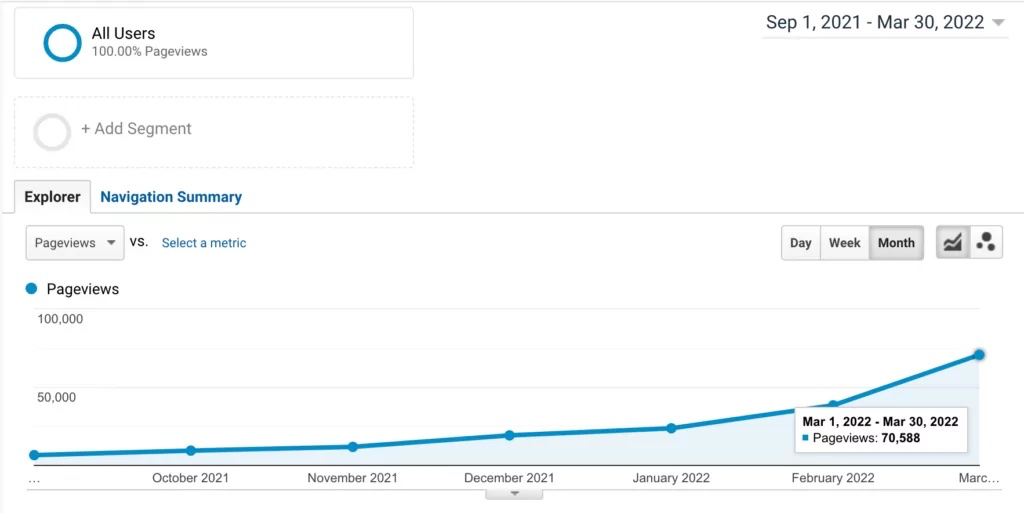
And like this:
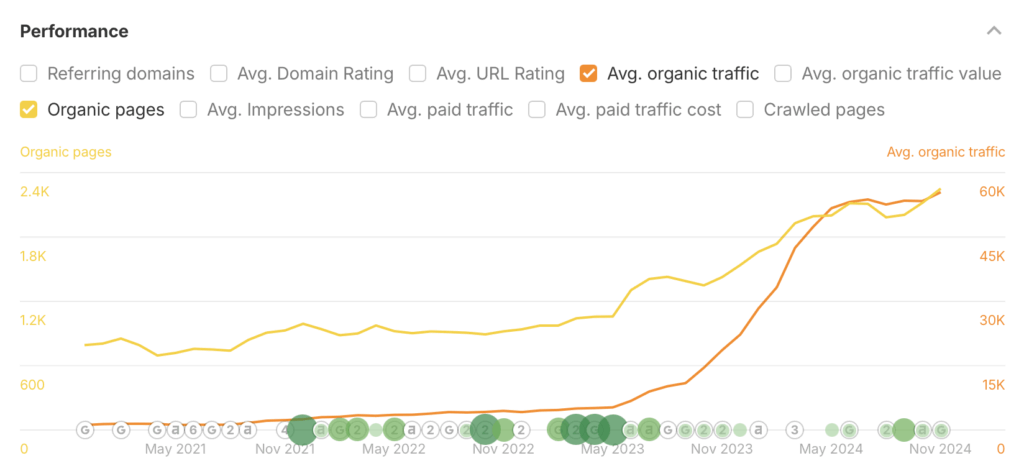
And like this:
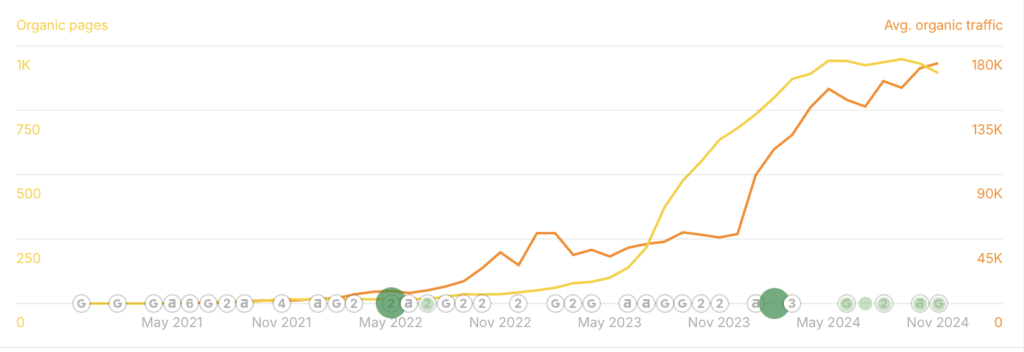
AND like this:

Four different sites, across different time periods, in wildly different industries, targeting wildly different customers.
But the same underlying Beachhead Principle.
This can and should be used on ~middling sites (think: ~DR 40-60) who have to compete against industry titans (think: ~DR 90+).
So in order to reliably predict SEO success, you need to start by prioritizing keywords and topics and content pieces that can reliably break into the top five — within a reasonable amount of time.
And for the time being, simply ignore or disregard the keywords or topics where top five rankings are difficult-to-impossible.
This, in turn, will allow you to set your sights higher a few months (or years) from now to then go after much bigger categories filled with SEO giants.
David ousted Goliath not by competing directly in a test of brute strength, but indirectly, through asymmetric warfare.
You need to do the same thing. Here’s how.
Why “time to results” determines which content topics to prioritize
SEO is the best digital investment because results compound.
Done correctly, your investment doesn’t grow 10% per month, or become 10% more cost effective, like PPC ad optimization.
Instead, it 10x’s. Then, it 10x’s again.
The catch? It can take a long Fing time to get the snowball rolling.
That’s why the most important (yet least discussed) concept for SEO projects is payback period or estimated “time to results.”
Like any other capital investment, you:
- Invest $X dollars/pesos/yen today, to
- Generate $Y dollars/pesos/yen tomorrow
BUT.
Instead of only taking days or weeks to produce results (like advertising), you’re looking at months or years. At a minimum.
Especially because most marketers (and their bosses holding the purse strings) are so busy focusing on lagging indicators — like traffic, leads, and sales — that they miss all the inputs or leading indicators bubbling beneath the surface.
So you can define your estimated “time to results” into a few easy groups:
- 0-6 months
- 6-12 months
- 12+ months
And by extension, you can prioritize the keywords / topics and content that you think will deliver short-term results (0-12 months) vs. long-term ones (12+ months). AND you do this before ever writing a single word.
Notice the reds and yellow on the image below? We’re estimating potential ROI timing while still analyzing net-new content ideas.

Now, here’s the catch.
Most companies need to balance both at the same time… capitalizing on low-hanging fruit to generate some short term results, while at the same time laying the groundwork for the more difficult campaigns that will generate a substantial ROI two years from now.
Why are we droning on and on and on about this?
Resource allocation.
‘Cause it’s the single biggest determining factor behind your ability to generate results (or lack thereof).
If you don’t get the long-term vision, direction, budget, and patience to plot this long, winding road, you’ll almost never be able to compete with industry giants long-term.
Despite how good or skilled or handsome or funny you are. And yes, that includes even my alpha-level wit.
Meaning you need to:
- Prioritize and establish a beachhead, ASAP!
- Leverage quick wins as evidence for proof of concept behind your idea,
- Illustrate to your boss that you need a bigger budget and team to continue rolling the SEO snowball downhill,
- Allow your boss to make a case to their boss that the ROI will be worth it 2+ years from now, if you and they are given the time + money to sustain the required marathon, and
- Freedom to make autonomous, strategic, long-term decisions without allowing other HIPPOS (highest paid person’s opinion) to squash your vision before it has a chance to take off
But the payback period alone won’t determine how fast or slow you can move.
It’s also linked directly with topical authority. Meaning, you will be able to move slow or fast depending on…
- Slow: Starting from scratch and need to create topical authority in a category
- Fast: Kinda/sorta have topical authority and need to continue doubling down to grow it
- Fastest: Already have topical authority and are ready to dominate
Another way we shortcut this is to determine your starting position, based on a simple proxy for existing site strength like DR:
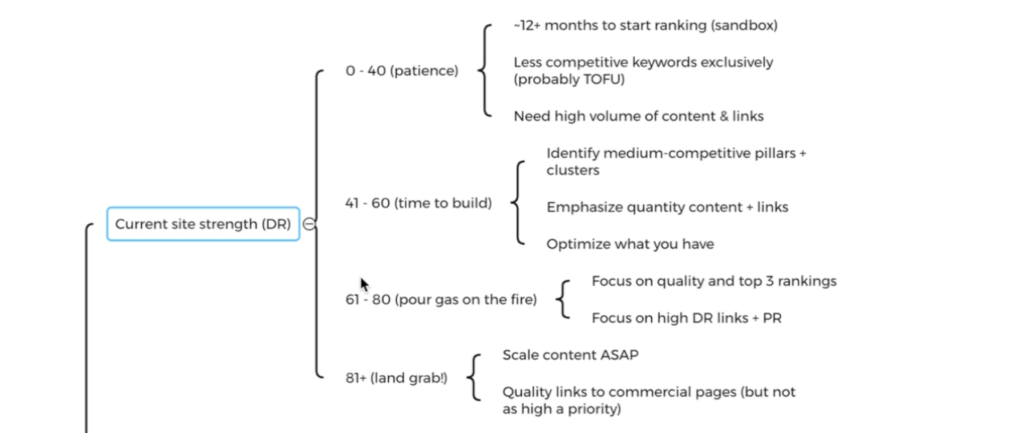
Then, we analyze the Growth Gap.
How far are you from existing direct competitors in the SERPs, and how do you go about closing this gap?
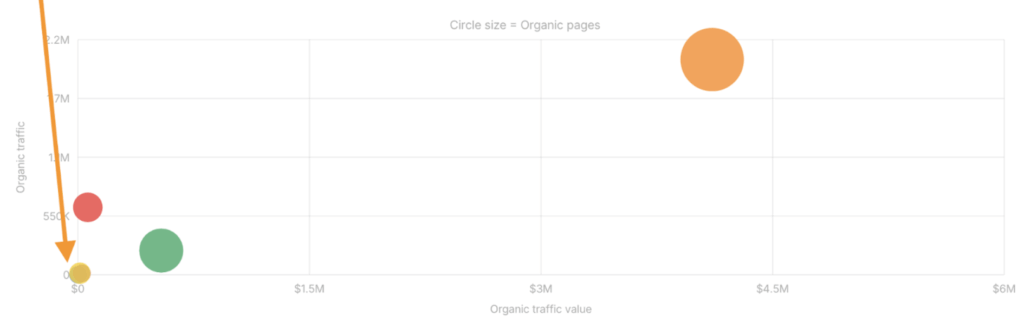
Then, contrast and compare your “inputs” that ultimately drive your “outputs” (like top five ranking positions, traffic, and leads). These typically include things like:
- The number of unique pages on the site,
- The number of unique referring domains, etc.
For example, if we were comparing the former:
| Domain | Number of pages | Gap to close |
| [Redacted client site] | 56 | |
| K12 | 3,536 | 3,480 |
| Connections Academy | 1,584 | 1,528 |
| Flvs | 589 | 533 |
| K12 Private Academy | 63 | 7 |
| Keystone School | 193 | 137 |
The goal isn’t to just figure out how much “extra” content to do. It’s to figure out how much work should be involved (at the very least), and where to find the biggest points of leverage.
Where do you establish a beachhead that will allow you to gain quick wins today, while still setting you up for compounding success tomorrow?
So if next year’s SEO & LLM results depend on this year’s work (which they do), then it’s time to get cracking on establishing your beachhead right now.
Establish your SEO beachhead by going deep & narrow (vs. broad & wide)
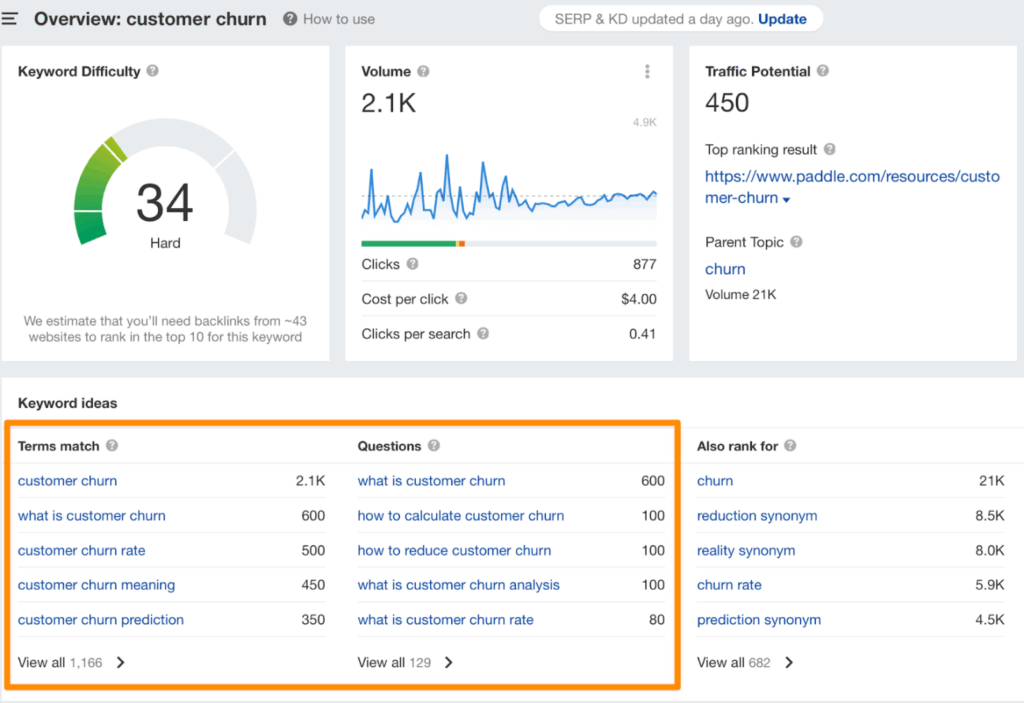
Let’s take a random SaaS keyword, like “customer churn.”
Volume looks pretty good, CPC indicates at least some buying intent, and the keyword difficulty looks hard but not impossible.
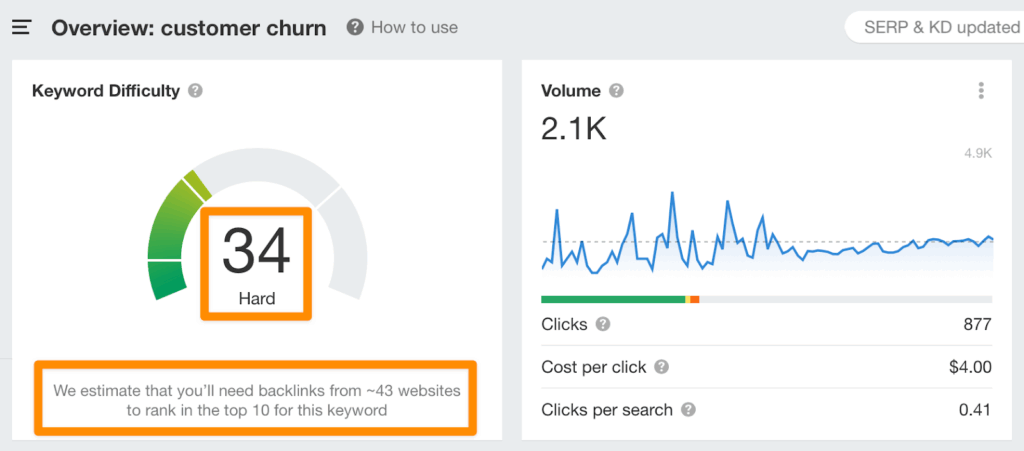
Please note that Keyword Difficulty is HEAVILY biased towards the number of referring domains pointing to each piece of content currently ranking, and doesn’t always indicate the overall domain strength of the sites currently ranking.
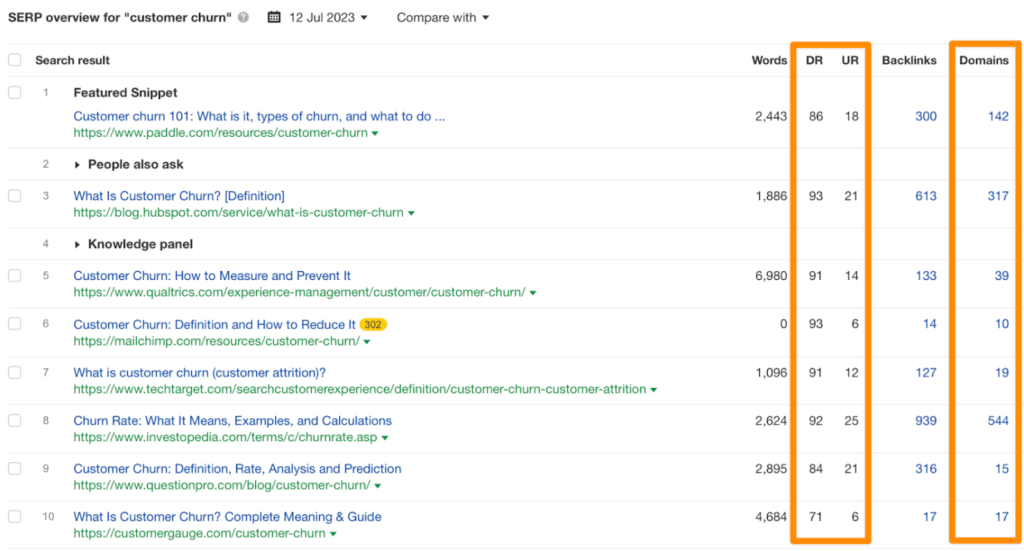
So an “Easy” KD in your favorite SEO tool could actually be a lot harder to rank for in reality because all those DR 90 sites ranking only have ~10 referring domains each.
Lemme illustrate this with an image below.
The quantity of referring domains to each existing content page currently ranking doesn’t look that difficult to compete against in theory.
HOWEVER, take one glance over at the average DR of the top ten and you quickly realize this will be an uphill battle. Fo’ sho.
Yikes.
Seven out of the top ten are DR 90+ sites. Two are mid-to-high 80s, while the last is the only one in the 70s.
So overall, from a domain-level perspective, this keyword is competitive AF!
Now, let’s say your site’s DR is in the ~50s. Respectable! It’s pretty good.
BUT not good enough to reliably outrank those competitors in the next few months alone.
That means a few things:
- You can and should work on increasing your own DR via high-quality referring domains (read: backlinks that don’t suck),
- ‘Cept that will take at least 12+ months in this example at the absolute minimum to crack a DR of 80 or 90,
- So right now, you need to set your sights on easier targets, in order to…
- Eventually come back and rank for “customer churn” ~12-24 months from now.
Making sense so far?
Your near-term strategy, then, should be to create a “customer churn” pillar, with a surrounding cluster of child pages based on easier-to-rank, longer-variation “Terms match” and “Question”-based queries:
Still with me so far?
Digging into these lists a little more, we can uncover some really solid near-term (again: ~0-12 months) options, like these related keywords for “predicting customer churn.”
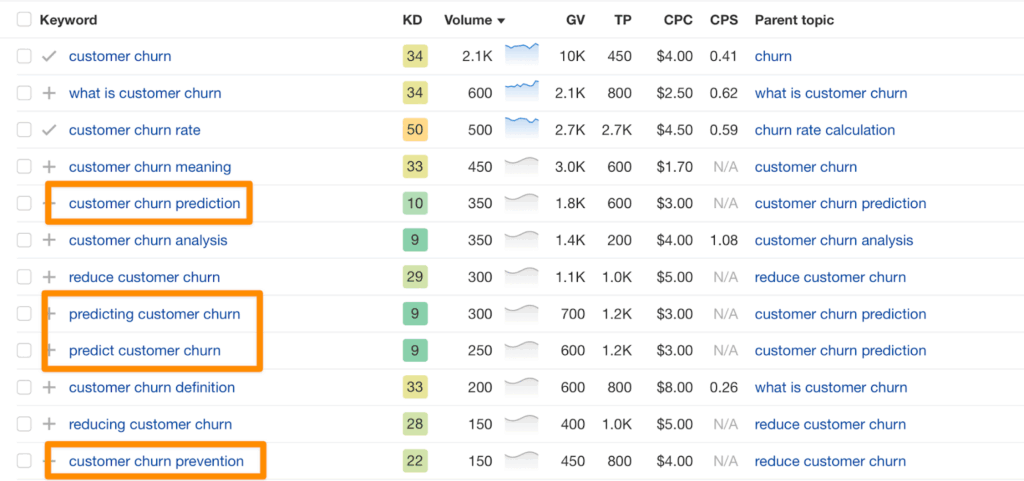
A little bit of SERP analysis across all of these will help you quickly see there is a fair bit of content overlap. Which means you can probably get away with creating one really really good, in-depth article vs. unique content for each slight variation.
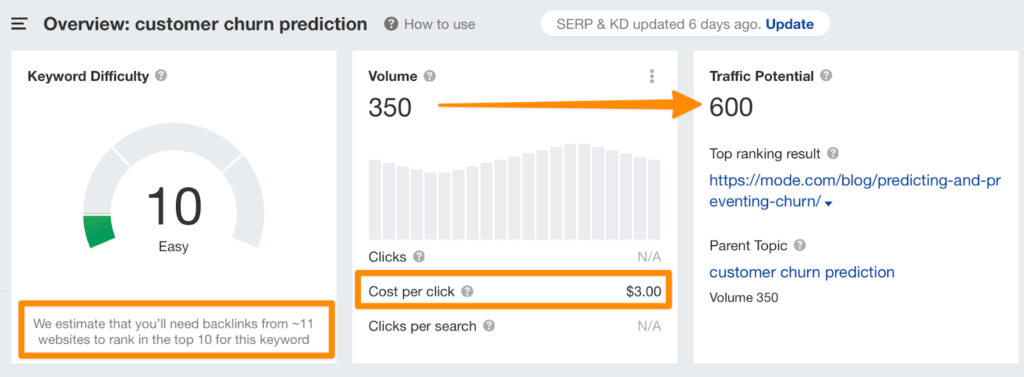
You can further validate this last sentence by looking at the relationship between “Traffic Potential” and “Volume” in one of these keywords.
The fact that Traffic Potential is ~2X your Volume typically means there is overlapping intent between a few closely-related keywords. Plus! The Keyword Difficulty looks more palatable on this long-tail variation (“customer churn prediction”), too.
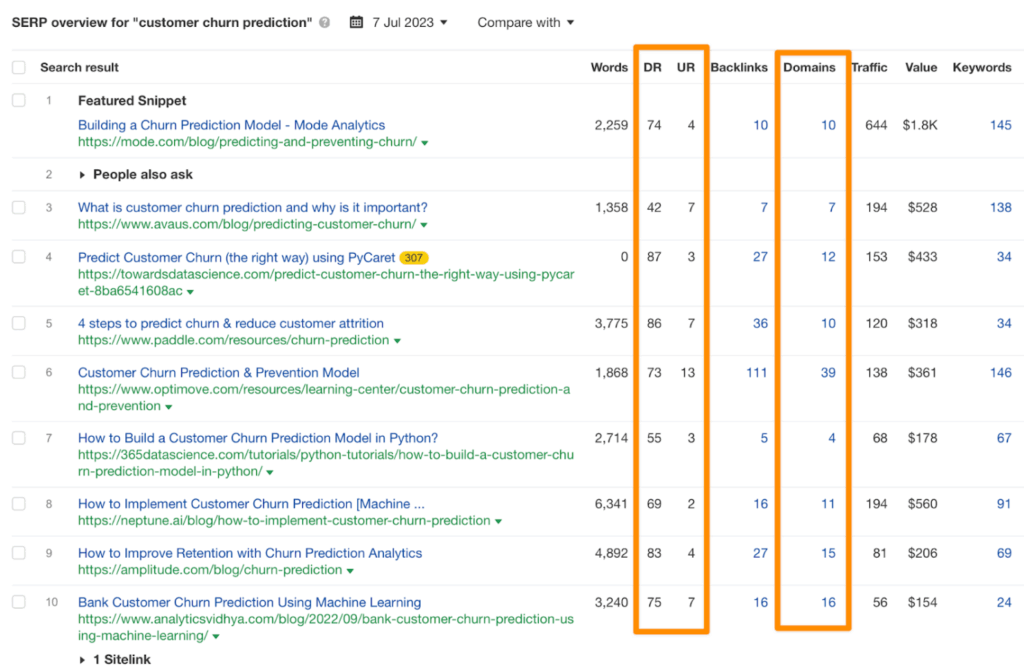
Of course, we can’t stop there. We need to cross reference the DR ranges like before again:
Voila!
While there’s still some heavyweights in there, you at least have a few competitors in the ~40 – 60 range — falling exactly within your own current weight class.
You can take them on!
Especially if you continue to go deep and narrow, becoming the go-to resource on all things “customer churn,” while even repurposing or updating existing content to provide a 0-6 month time to results (read: top five ranking + traffic flows).
Only after exhausting one defined area should you think about branching out into other adjacent pillars and clusters.
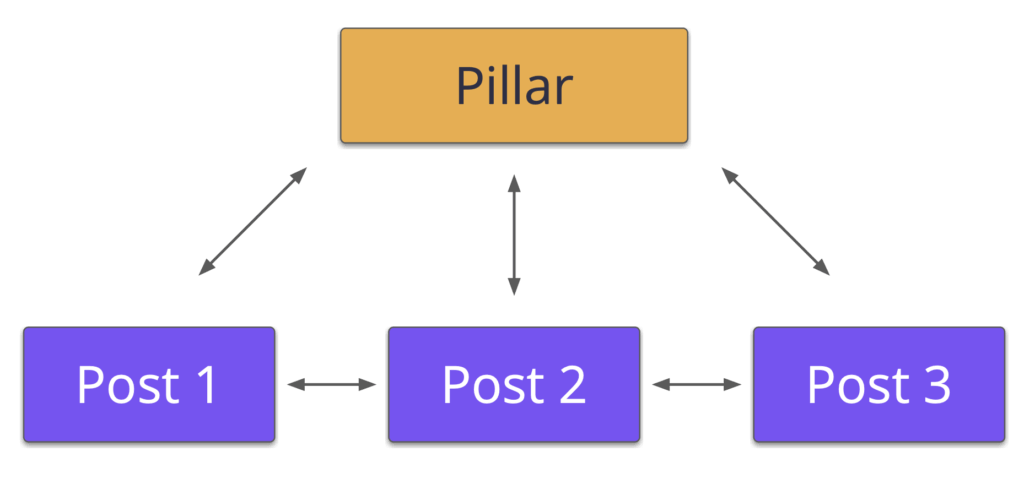
The reason is because you can leverage topical authority in one area — your beachhead! — to branch out and successfully start taking territory away from others.
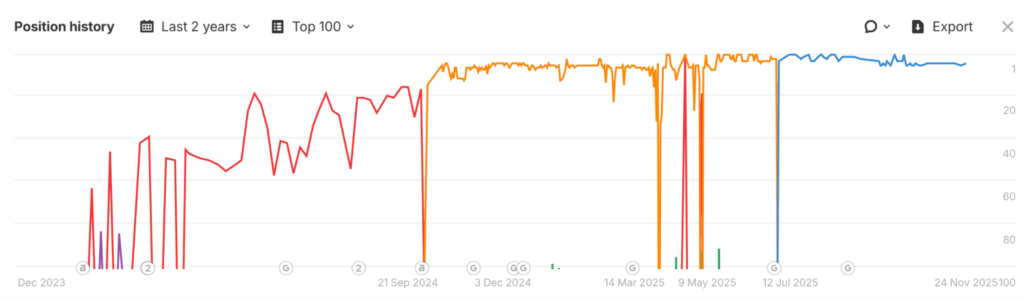
How do you know if you’re on the right track or not? Watch these leading indicators!
Indicator #1. How fast is the content going from “not indexed” to ~page two?
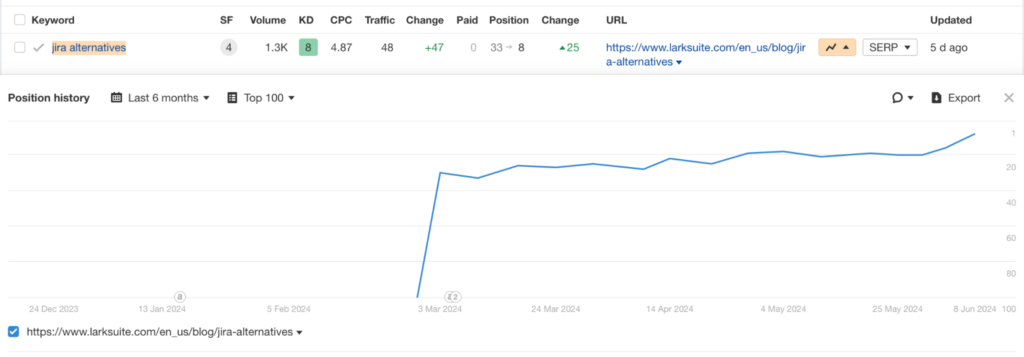
Achieving this in just a couple weeks indicates a high probability of first-page within six months.
Indicator #2. How fast is all recently published content moving from lower ranking positions to first-page ones?
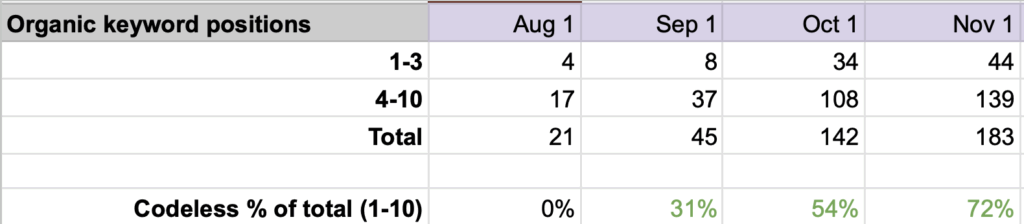
You’ll be able to see the tide lifting all boats before visits explode in GA (or better yet, Matomo).
Indicator #3. How are your specific beachhead content types or topic categories contributing to these aggregate ranking positions or share of traffic?
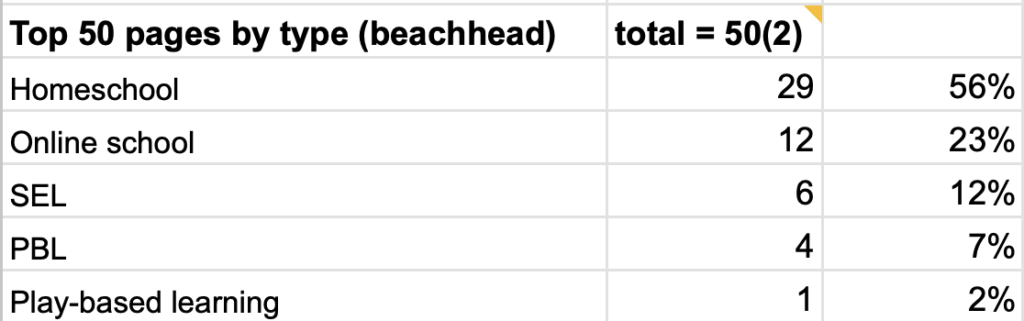
THESE are the early indicators that tell you whether (or not) you’ll get top ranking positions and yes, even LLM citations:
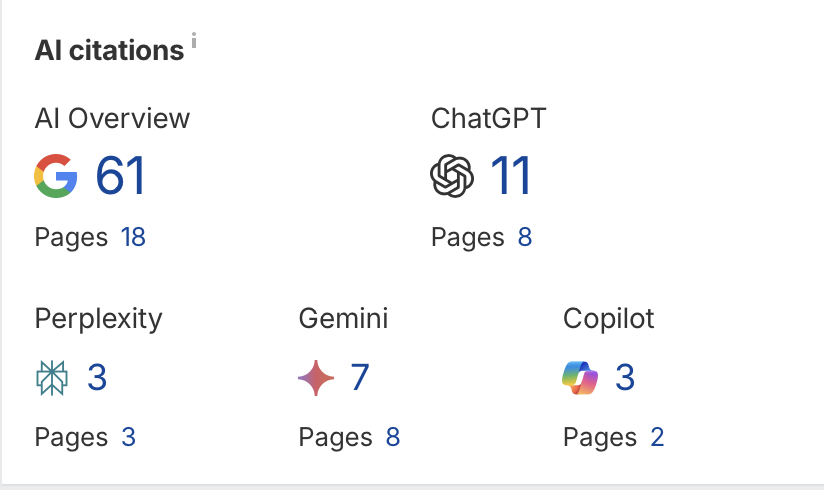
This last example is critical, because that’s 18 pages in AIO Overviews on a new site with only about ~50 articles in less than 6 months. Without any active link or citation building. A 36% hit rate is LIGHTYEARS better than the vast majority of sites.
Now, comes the tough part. You rinse and repeat. For months.
And only then do those “hard” keywords that used to look really difficult now become “much easier” to rank for — faster! — based largely on top of the existing topical authority your beachhead has delivered.
Don’t get me wrong.
In most competitive spaces on the Internet (read: the one you’re probably working in if there’s a lot of money floating around), you’ll still need to create a link building engine in the background.
But the point is the point:
- You establish a beachhead in one fruitful area that’s highly relevant to your core product or service,
- You gain traction on less competitive, yet still relevant keywords,
- You slowly go from page two to position two, increasing traffic 10X at least across each URL that makes this jump, and then…
- You move the goal posts back, now adjusting your sights on the top spots in the space,
- ONLY when you have the existing topical authority and site size that make your payback period more palatable (and realistic).
It’s not easy per se.
The pros — the ones doing this repeatedly, over the long haul, proving success across categories or websites — just keep their heads down and continue plugging away.
Like how we helped monday.com scale traffic over 600%+ in two years.
No tricks or gimmicks. No crap AI content. Just a well-oiled content engine.
And, trusting the process.
Focusing exclusively on executing month after month, year after year, so that the results take care of themselves.
Conclusion
There are often two primary reasons most SEO/GEO + content campaigns fail to deliver results:
- You (or your boss) unrealistically set sights too high on keywords completely out of your each (in the near future), and
- You (or your boss) pulls the plug too early, changes direction, and doesn’t allow enough time to pass to bear fruit
That’s it!
Simple at the end of the day.
Either you set the wrong targets from the beginning, or you fail to execute over the long-term.
Both are cardinal sins in SEO. Both will sabotage your efforts.
Like losing weight, they’re focusing on the inputs of food they eat, number of steps they take, etc. And let compounding do its thing.
Instead of focusing on the outputs, or lagging indicators, like the number of pounds lost on a scale.
Weight loss, like SEO results, goes slowly. And then suddenly.
Months become years. And then comes success.